Table of Contents
- What Makes the Best Shore Excursions for Cruise Passengers
- Cozumel Excursions for Families: Activities Everyone Can Enjoy Together
- Cozumel Excursions for Non-Swimmers: Accessible Underwater Experiences
- Cruise Line Excursions vs Independent Tours: Which Option Works Best
- Cozumel Snorkeling Tours and Alternatives for All Skill Levels
- Timing, Safety, and Ship-Return Guarantees: What Cruise Passengers Need to Know
- Frequently Asked Questions
Last Updated: October 11, 2026
What Makes the Best Shore Excursions for Cruise Passengers
When your cruise ship pulls into port, you must choose between crowded tours and genuine adventure. The best shore excursions for cruise passengers balance accessibility, time efficiency, and immersion, delivering experiences you can’t have at home while ensuring you return before departure.
Passengers who report the most memorable experiences pick excursions designed for their specific situation, not generic tours. Whether traveling with multiple generations, unable to swim, or on a tight schedule, the right choice depends on understanding what different excursion types deliver.
The best shore excursions match your physical abilities, time constraints, and interests. This guide explains what separates memorable port days from forgettable ones.
Cozumel Excursions for Families: Activities Everyone Can Enjoy Together
Multi-generational trips require excursions that work for ages 9 to 70+, balancing adventure with comfort and safety on a shared schedule.
Traditional snorkeling requires swimming ability and comfort in open water, excluding children who panic or older adults with arthritis. Helmet diving eliminates these barriers: ages 8 to 80+ walk the ocean floor together without swimming skills or certification, breathing naturally and moving at their own pace.
You walk on sand watching sea life at eye level, not floating on the surface. A guide adjusts pace for each participant. The two-hour total duration fits cruise schedules perfectly.
Cozumel Excursions for Non-Swimmers: Accessible Underwater Experiences
Fear of water keeps many passengers from Cozumel’s underwater world, assuming snorkeling requires ocean confidence or scuba demands certification. Helmet diving eliminates both barriers.
Helmet diving solves the non-swimmer problem: you walk the seafloor, breathing normally, with plenty of light and visibility, giving anxious swimmers the control they need.
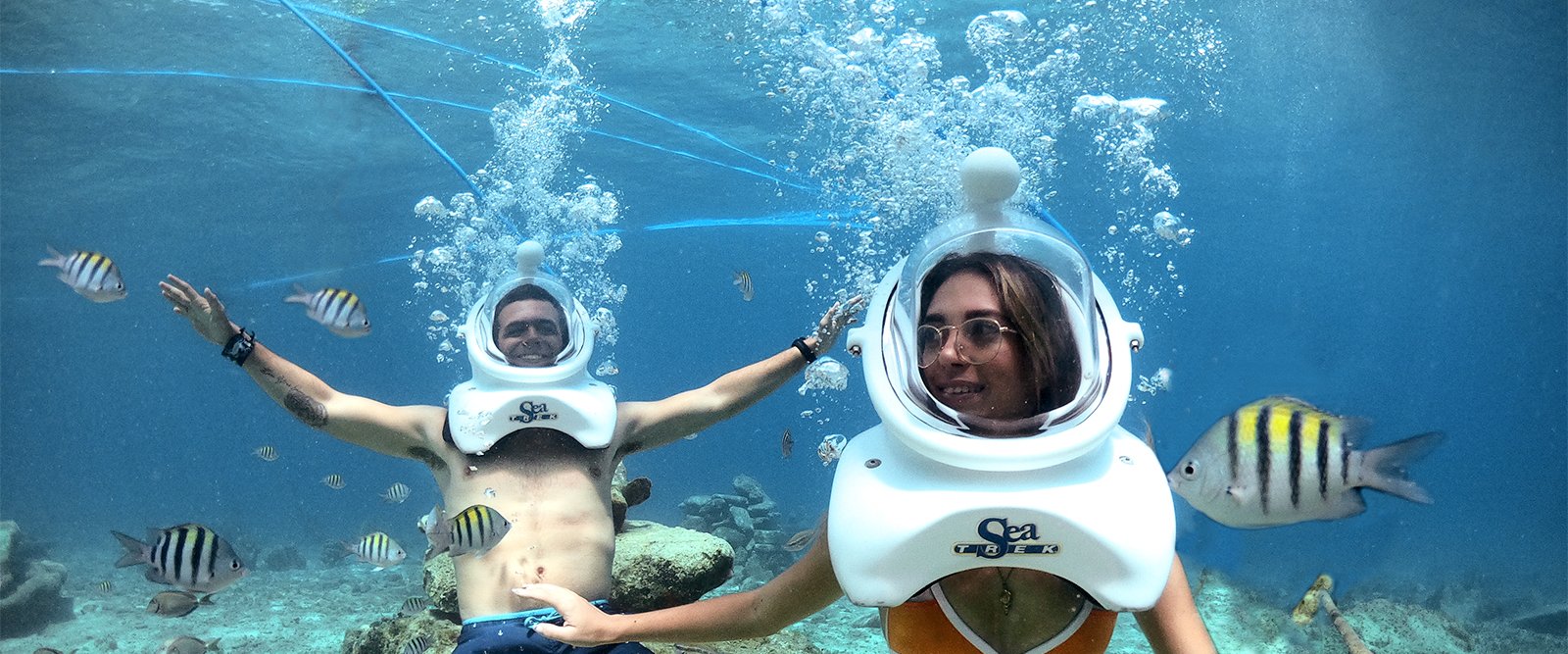
A multi-generational group of passengers in specialized helmet diving gear walking on the ocean floor, smiling and pointing at colorful coral formations and tropical fish, with clear turquoise water and sunlight filtering down from above
Panic underwater stems from loss of control, not water itself. Standing on solid ground shifts the dynamic entirely: you’re exploring, not struggling. Guides trained for nervous participants provide reassurance through clear hearing, breathing, and visibility.
Cruise Line Excursions vs Independent Tours: Which Option Works Best
Cruise lines and independent operators both offer excursions. The choice depends on what matters most: absolute certainty of return, or personalized experience with manageable logistics.
Cruise Line Excursions: The Safety Net
Cruise line excursions guarantee return before departure, backed by the cruise line’s liability and reputation. If your tour runs late, the cruise line covers it and coordinates with the ship. You’re never at risk of being left behind.
The trade-off: standardization and large groups (30-50 passengers). Tours follow predetermined routes with scripted guides and median-passenger pacing. Pricing is higher because the cruise line absorbs liability and coordination overhead.
At ports without dedicated terminals, passengers tender to shore in small boats. Cruise line tours depart from the tender dock; independent tours require you to complete tendering first, adding 30-60 minutes on busy days.
Independent Tours: Customization and Control, With Real Logistics to Manage
Independent tours offer smaller groups (4-12 vs. 40-50), personalized pacing, and lower pricing. Guides adjust to your group’s interests and fitness level, creating personal rather than industrial experiences.
You manage timing: tendering, travel, activity, return travel, and re-tendering within your port window. Reputable operators build in buffer time and communicate exact timing, but the logistics chain has more variables.
If an independent tour runs late: minor delays (15-30 min) are covered by built-in buffers; moderate delays (30-60 min) require operator communication with the port agent, though the cruise line may not hold the ship; severe delays (60+ min) are rare but require operator insurance coverage. Always verify delay policies before booking.
Reputable operators mitigate risk by: monitoring tender schedules and adjusting departure times; building 90-minute buffers before the latest tender window; carrying liability insurance for delays and missed ships; providing clear written policies in confirmation emails; and offering weather cancellation policies with full refunds or rescheduling.
Tendering is hidden complexity many passengers don’t anticipate. On busy days, tendering can take 45-90 minutes. Before booking, ask: “What time should I be back at the tender dock?” A responsible operator gives a specific time, not a vague deadline. Vague answers are a red flag.
Choose cruise line excursions if you’re risk-averse, traveling with elderly passengers or young children, want minimal logistics, or are cruising for the first time. Choose independent tours if you want personalization and smaller groups, are comfortable managing logistics, have cruised before, or want experiences cruise lines don’t offer.
For Cozumel, independent operators like SEA TREK offer helmet diving, which most cruise lines don’t. The trade-off of managing your own timing is worth it if helmet diving is your goal. Book operators with verifiable cruise passenger reviews, clear written policies, and on-time track records.
Factor | Cruise Line Tours | Independent Tours |
|---|---|---|
Group size | 30-50+ passengers | 4-12 passengers |
Customization | Minimal | High |
Ship-return guarantee | Yes, cruise line covers delays | Operator-dependent; verify policy |
Pricing | Higher | Often lower |
Tendering logistics | Depart from tender dock | You complete tendering first |
Buffer time | Built in; cruise line manages | Operator should build in 30-45 min |
Best for | Risk-averse, first-time cruisers | Experience-focused, repeat cruisers |
Independent tours are not inherently riskier with reputable operators and clear logistics understanding. The risk is manageable. Cruise line tours eliminate logistics burden but cost more and offer less personalization. Choose based on your priorities and comfort with timing management.
Cozumel Snorkeling Tours and Alternatives for All Skill Levels
Snorkeling is the default Cozumel activity with spectacular reefs, but “accessible” doesn’t mean comfortable for everyone. Understanding what different water excursions deliver is essential to choosing one you’ll enjoy.
Traditional Snorkeling: What It Requires and What It Delivers
Snorkeling requires floating on the surface, breathing through a tube, seeing the reef from above at 10-30 feet depth. Success depends on comfort in open water, swimming ability, and tolerance for currents and waves.
Snorkeling works for confident swimmers with no mobility issues who want to cover multiple reef sites. It’s risky for non-swimmers, those with arthritis or joint issues, older adults with balance problems, people with water anxiety, and those with ear or sinus issues.
Snorkeling tours: 3-4 hours, 15-30 passengers, $45-$120 per person. Includes equipment, boat, guide, life jacket. Extras: lunch ($10-$20), camera rental ($15-$30), gratuities (15-20%). Physical demands: moderate to high.
Cozumel’s reefs are world-class with year-round clarity, healthy coral, and remarkable fish variety. For confident swimmers, snorkeling delivers value: short boat rides, 80+ foot visibility, and sightings of parrotfish, angelfish, grouper, rays, and sea turtles.
Snorkeling is weather-dependent. Afternoon storms (June-September) create rough seas and poor visibility; operators cancel if waves exceed 3-4 feet. Verify weather cancellation policies and refund/rescheduling options.
Helmet Diving: An Alternative for Non-Swimmers and Accessibility-Focused Passengers
Helmet diving eliminates the barriers that make snorkeling uncomfortable or impossible for many passengers. You walk on the seafloor in shallow water (typically 20-30 feet), breathing naturally through a helmet system. You’re not floating, not treading water, not fighting currents.
Helmet diving works for non-swimmers, older adults, those with mobility issues, water-anxious passengers, those with ear/sinus problems, families with children 8+, and those wanting close-up reef views.
Helmet diving tours: 1.5-2 hours, 4-8 passengers. Includes equipment, guide, orientation, beach club access, snorkel gear. Extras: photos, lunch, gratuities. Physical demands: low.
Helmet diving positions you at eye level with fish and coral. Stationary positioning means fish aren’t startled by movement, so many passengers see more marine life than in snorkeling. The psychological shift is significant: you’re exploring, not struggling.
Scuba requires Open Water Diver certification. Cozumel is world-class with close reefs, excellent visibility, and extensive sites. Tours run 3-4 hours, cost $100-$180, and visit 1-2 sites. “Discover Scuba” courses ($150-$250) require open water comfort and aren’t suitable for non-swimmers or anxious passengers.
Glass-bottom boats let you view reefs without entering water, suitable for non-swimmers and mobility-limited passengers. Tours run 1-2 hours, cost $40-$70, work for all ages. Trade-off: limited visibility and passive rather than immersive experience.
Comparison: Which Water Excursion Matches Your Situation?
Activity | Swimming Required | Physical Demands | Group Size | Duration | Price Range | Best For |
|---|---|---|---|---|---|---|
Snorkeling | Yes (confident) | Moderate-high | 15-30 | 3-4 hours | $45-$120 | Confident swimmers, reef coverage |
Helmet Diving | No | Low | 4-8 | 2-2.5 hours | $99-$150 | Non-swimmers, accessibility, families |
Scuba Diving | Yes (certified) | Moderate | 4-8 | 3-4 hours | $100-$180 | Certified divers, experienced explorers |
Glass-Bottom Boat | No | Minimal | 20-40 | 1-2 hours | $40-$70 | Mobility-limited, water-averse passengers |
Ask yourself: Am I comfortable swimming in open water? Do I have mobility or joint issues? How much time do I have? Do I want close or distant reef views? Am I traveling with multiple ages and abilities?
Match the activity to your abilities and preferences, not to anxiety or discomfort. The best shore excursion is the one you actually enjoy.
Timing, Safety, and Ship-Return Guarantees: What Cruise Passengers Need to Know
Your cruise port window is fixed. Most Caribbean ports give you 6-8 hours ashore. Subtract travel time to the excursion location, and you’re working with 4-5 hours of actual activity time. The best shore excursions for cruise passengers respect this constraint rather than ignore it.
A quality excursion communicates exact timing upfront. Total duration should be clearly stated, including water time, orientation, and travel. SEA TREK Cozumel‘s helmet diving experience runs approximately two hours total, which leaves you time to explore the beach club, grab lunch, or shop before returning to the ship. The operation is timed to align with typical cruise schedules, so you’re never rushing.
Safety protocols matter more with independent tours because you’re not under the cruise line’s umbrella. Reputable operators carry liability insurance, train guides in water safety and emergency response, and maintain equipment to professional standards. Before booking any independent excursion, verify that the operator is licensed, insured, and has verifiable customer reviews from actual cruise passengers.
Weather is the wild card. Cozumel’s hurricane season runs June through November. Even outside that window, afternoon storms can develop quickly. The best operators have clear policies about weather-related cancellations and rescheduling. If an excursion is cancelled due to conditions, you should be offered a full refund or a different tour date with no penalty.
Choosing the best shore excursions for cruise passengers comes down to honest self-assessment. What’s your swimming ability? Who are you traveling with? How much time do you actually have? What would make this port day feel like a genuine adventure rather than a checkbox on a cruise itinerary?
SEA TREK Cozumel specializes in the excursion that works when other options don’t, helmet diving that requires no swimming skills, no certification, and no physical limitations based on age. Our small-group format, port-convenient location, and two-hour duration fit perfectly into cruise schedules. Every tour includes equipment, professional guides trained in water safety, and free entrance to Jeanie’s Beach Club. The U.S. Coast Guard provides safety guidelines for water activities that reputable operators follow. Get started with SEA TREK Cozumel and experience Cozumel’s underwater world in a way that works for your family.
Frequently Asked Questions
How do I choose a shore excursion that fits my cruise schedule?
Check your ship’s port schedule and allow at least 30-45 minutes buffer before departure. Choose excursions with guaranteed ship-return assurances and confirm duration with the operator before booking. For cruise passengers with limited time, opt for excursions located near the port to minimize travel time. Ask about group size and whether transportation is included, as these factors directly impact your total time away from the ship.
Are there shore excursions suitable for families and non-swimmers in Cozumel?
Yes. Helmet diving experiences allow non-swimmers and children as young as 8 to explore underwater environments without swimming ability or certification. These excursions are specifically designed for multi-generational groups, with trained guides managing safety and comfort. Families also enjoy island tours, cultural experiences, and beach activities that don’t require water skills. Always verify age restrictions and physical requirements before booking.
Should I book a shore excursion through the cruise line or independently?
Cruise line excursions offer ship-return guarantees and simplified logistics but typically cost more. Independent tours provide flexibility, often lower pricing, and personalized experiences. Choose cruise line options if you prefer peace of mind and minimal planning; select independent providers if you want customization and cost savings. Verify cancellation policies, insurance coverage, and back-to-ship assurances regardless of which option you select.
What’s the difference between snorkeling and helmet diving for cruise passengers?
Snorkeling requires floating at the surface with a mask and breathing tube, demanding basic swimming comfort and balance. Helmet diving allows you to walk on the ocean floor while breathing naturally through a specially designed helmet, requiring no swimming skills or certification. Helmet diving offers closer encounters with coral and marine life and suits non-swimmers, nervous swimmers, and those with mobility concerns. Both provide rewarding underwater experiences; your choice depends on comfort level and physical ability.