Last Updated: October 25, 2026
Quick Summary
Helmet diving is safe for most seniors because the helmet sits on your shoulders, you breathe normally, and a guide stays within arm’s reach. However, heart conditions, unmanaged blood pressure, and poor balance change the answer, so talk to your doctor first.
- Age alone does not disqualify anyone from helmet diving; medical fitness does.
- You need to climb a short ladder, stand unassisted, and walk 20 to 30 minutes without rest.
- Depth stays shallow, typically around 3 to 4 meters, which keeps pressure changes mild.
- Tell your guide before you descend if you are nervous; guides can hold your hand and bring you up early.
- Ask about the participant-to-guide ratio; a common standard is one guide for every two to four participants.
Table of Contents
- Is Helmet Diving Safe for Seniors? What Older Adults Should Know
- How Helmet Diving Works and Why It Suits Older Adults
- Why Helmet Diving Is Different from Scuba and SNUBA
- Helmet Diving Health Requirements for Older Adults
- Helmet Diving Physical Requirements: Mobility, Balance, and Water Confidence
- Helmet Diving vs Scuba Diving for Seniors
- What to Expect on a Helmet Diving Tour: Step by Step
- Warning Signs, Pressure, and Cold: Staying Safe During the Dive
- How to Choose a Helmet Diving Operator You Can Trust
- Book Your Family’s Helmet Dive with Confidence
- Frequently Asked Questions
Is Helmet Diving Safe for Seniors? What Older Adults Should Know
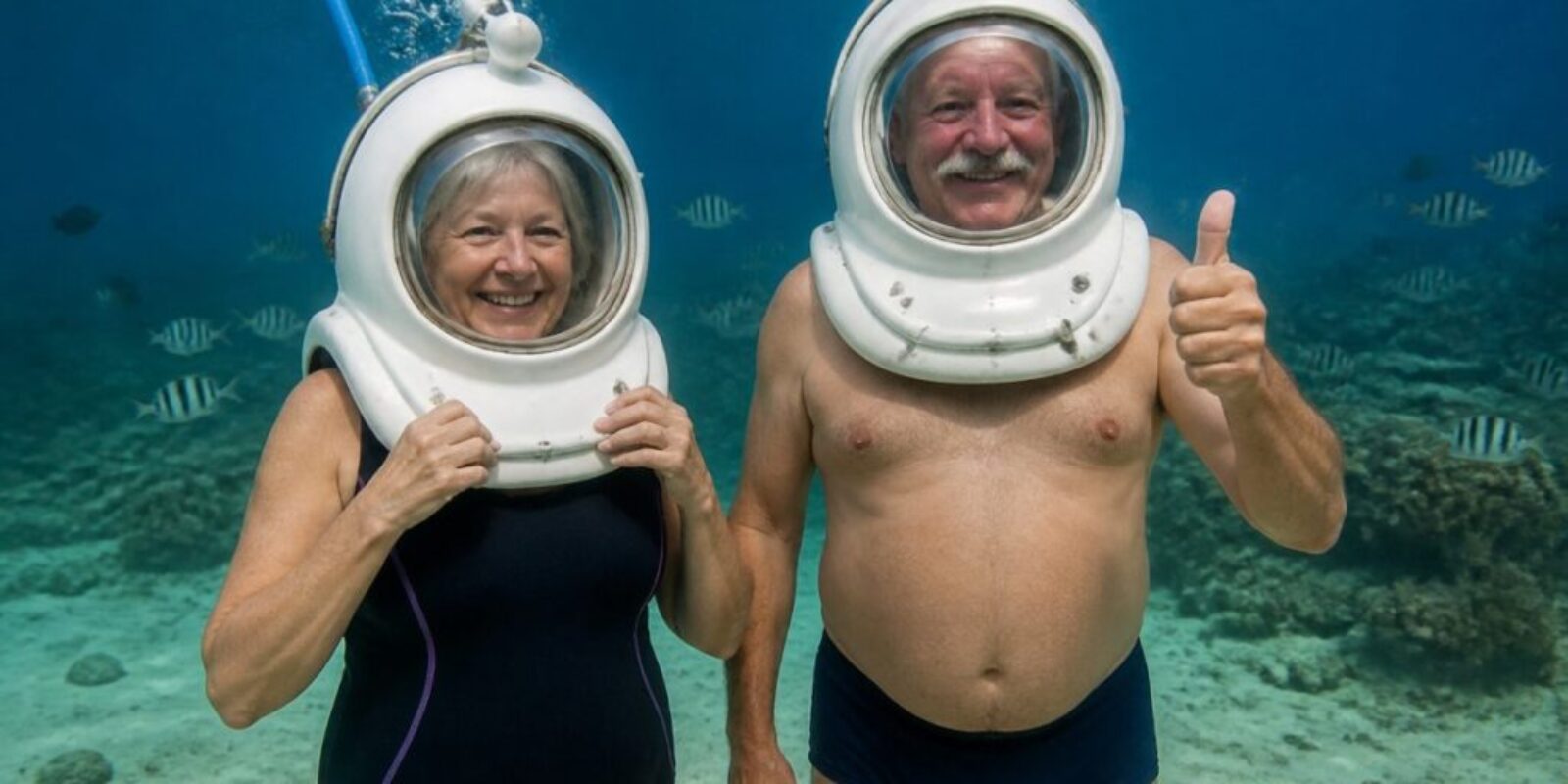
Helmet diving is safe for most seniors and is one of the few underwater activities built for people who cannot swim or hold a scuba certification. At SEA TREK Cozumel, the helmet sits on your shoulders, you breathe normally, and a guide stays within arm’s reach.
“Safe for most” is not “safe for everyone.” Heart conditions, unmanaged blood pressure, and poor balance change the answer. Below: the health requirements, physical demands, and how helmet diving differs from scuba.
How Helmet Diving Works and Why It Suits Older Adults
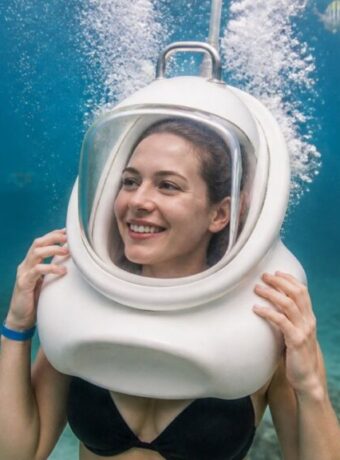
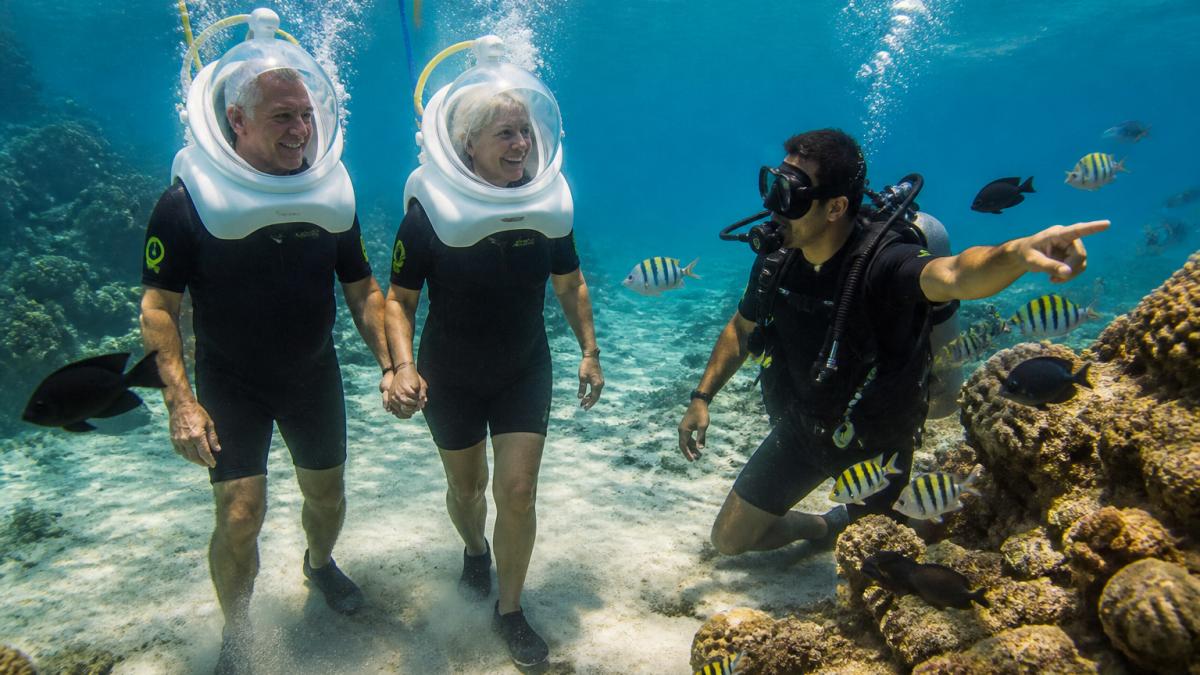
Helmet diving is a guided underwater walk where you wear a weighted helmet filled with continuously pumped air, descend a ladder to the seabed, and breathe normally while you explore. No regulator goes in your mouth, no tank straps on your back. Why that matters for older adults:
- Your face and hair stay dry, so there is no mask squeeze or water up the nose
- You breathe through your nose and mouth exactly as you do on land
- You walk upright rather than swimming horizontally
The helmet is heavy on land and light underwater, since buoyancy does the lifting once you are submerged. Our guide on breathing normally during helmet diving explains the air system step by step.
Why Helmet Diving Is Different from Scuba and SNUBA
Scuba asks you to manage a regulator, a buoyancy compensator, and a depth gauge while swimming. SNUBA keeps you tethered to a surface raft but still puts a regulator in your mouth.
Helmet diving removes all three demands at once: no mouthpiece, no swimming, no buoyancy control.
For a senior with arthritis, a replaced knee, or a lifelong fear of water, that difference is the whole ballgame.
Helmet Diving Health Requirements for Older Adults
Age alone does not disqualify anyone; medical fitness does. Operators screen for conditions that make pressure changes, exertion, or cold water risky.
Heart, Blood Pressure, and Medication Considerations
Your heart works harder underwater, and cold water tightens blood vessels. That combination matters more at 70 than at 30.
Talk to your doctor first if you have any of these:
- Uncontrolled high blood pressure
- A recent heart attack or stroke
- Angina or an irregular heartbeat
Medications deserve their own conversation. Some blood pressure drugs affect how your body handles cold and exertion. Others cause drowsiness. Bring your full medication list to your doctor and ask one direct question: “Can I walk on the ocean floor at shallow depth with a helmet?”
Get the answer in writing if your operator requires it.
A Pre-Activity Health Checklist for Seniors
Run through this list before you book. A “no” on any line means a call to your doctor, not an automatic cancellation.
- Blood pressure is controlled and stable
- No heart attack, stroke, or chest surgery in the past 12 months
- No untreated asthma or breathing condition
Most operators ask you to complete a health waiver before the tour. You can review the Sea Trek Cozumel medical waiver in advance so there are no surprises at check-in.
Helmet Diving Physical Requirements: Mobility, Balance, and Water Confidence
The physical bar is low, but it is not zero. You need to climb a ladder, stand on a moving boat deck, and walk on sand.
Three abilities matter most:
- Mobility: step up and down a ladder, walk a few steps unaided
- Balance: stand still while the helmet is lowered onto your shoulders
- Water confidence: tolerate being submerged to the shoulders
You do not need to swim, but you do need to stay calm. If panic is your worry, tell your guide before you descend; guides are trained to hold your hand, slow the pace, and bring you up early. For exact age and weight limits, our frequently asked questions about the tour cover what to wear.
Helmet Diving vs Scuba Diving for Seniors
Scuba gives you freedom and depth. Helmet diving gives you simplicity and supervision. For most seniors, the second list wins.
| Factor | Helmet Diving | Scuba Diving |
|---|---|---|
| Certification needed | None | Yes, open water course |
| Swimming ability | Not required | Required |
| Breathing method | Natural, through helmet | Regulator in mouth |
| Typical depth | Shallow, walkable | Deeper, varies widely |
| Physical demand | Low, walking pace | Moderate to high |
| Supervision | Guide beside you | Buddy system |
| Best for | Non-swimmers, older adults | Certified, confident swimmers |
One caveat: helmet diving is not a substitute for a medical checkup. If your doctor has ever told you to avoid pressure changes, listen to that over anything you read online. For a fuller comparison and non-swimmer tips, see our breakdown of why helmet diving is worth it.
What to Expect on a Helmet Diving Tour: Step by Step
The sequence below is standard across most operators; understand each step before you commit.
- Check-in and health waiver. You complete a brief medical questionnaire. Bring your medication list and any written clearance your doctor provided. The crew reviews your answers and flags anything that needs a conversation before you gear up.
- Safety briefing. Your guide explains the helmet air system, hand signals, equalizing, and what to do if you feel uneasy. Ask questions here, not at the ladder.
- Gear fitting on deck. You try the helmet on land so you feel its weight and learn how it seals at the neck. The crew checks the air flow before you enter the water.
- Entry and ladder descent. You climb down a ladder while the helmet is lowered onto your shoulders at the waterline, spotted from above and below. You descend slowly, equalizing as you go.
- The walk. You follow a roped or marked path across the seabed, guide at your side. Depth is typically shallow so pressure changes are mild.
- Ascent and exit. You climb the ladder while the crew removes the helmet. A deckhand helps you onto the boat or platform.
- Debrief. Towels, photos, and a chance to ask questions.
Helmet and Air Supply: What Keeps You Breathing
The helmet is not a sealed tank. It is a rigid dome that sits on your shoulders with a soft neck seal, and air is continuously pumped in from the surface through a hose.
Before you descend, the crew should confirm air is flowing and the hose is secure. If air flow ever stops, the helmet holds enough breathable air for a short period while the guide brings you up, but never test that.
Hand Signals You Will Use
You cannot talk underwater, so the briefing will cover a small set of signals. Common ones include:
- OK, thumb and forefinger in a circle, or a thumbs-up depending on the operator
- Not OK / problem, flat hand rocking side to side
- Go up, thumbs up (confirm the operator’s meaning, since some use thumbs up for OK)
Ask your guide to demonstrate each signal and confirm you can repeat it before you descend. If you forget one underwater, point to your ear or give the not-OK signal.
What Happens If You Feel Uncomfortable
Tell your guide before you descend if you are nervous; guides are trained to hold your hand, slow the pace, and bring you up early.
Warning Signs, Pressure, and Cold: Staying Safe During the Dive
Depth stays shallow, which keeps pressure mild. You will still feel a slight squeeze in your ears on the way down.
Know these signals and raise your hand if any appear:
- Ear pain that does not clear
- Dizziness or nausea
- Shortness of breath
Cold is the quiet risk. Older adults lose body heat faster, and fat tissue and metabolism both shift with age. A rash guard or thin wetsuit helps.
Watch out: never descend with a blocked sinus or an active cold.
How to Choose a Helmet Diving Operator You Can Trust
The operator matters more than the equipment. Ask these questions before you book, and listen for specifics rather than reassurances.
Staff training and supervision
- Are guides certified in first aid, CPR, and rescue? Ask which certification body and whether it is current.
- What is the participant-to-guide ratio in the water? A common standard is one guide for every two to four participants; larger groups mean less individual attention.
- Does a guide stay beside each participant for the entire walk, or do guides lead from the front?
Equipment and air supply
- How often are helmets, hoses, and compressors inspected and logged? Ask to see the log if you are unsure.
- Is there a backup air supply or compressor on site in case the primary fails?
- Are helmets fitted with a communication system, or does the guide rely on hand signals alone?
Emergency planning
- What is the emergency plan if a participant has chest pain, dizziness, or panic underwater?
- Is there oxygen and a first-aid kit on the boat or platform?
- How quickly can the crew reach emergency medical services, and do they have a written procedure?
Participant screening and cancellation
- Does the operator review health waivers before departure, or only at check-in?
- What is the cancellation and refund policy if you are medically advised not to dive?
- Can you postpone to another day if you feel unwell on the morning of the tour?
A good operator answers all of these without hesitation and gives you specifics, ratios, depths, certification names, and policy terms. A vague answer on any of them is your cue to walk away.
To see what a thorough pre-dive screening looks like, review our medical waiver before you book.
Book Your Family’s Helmet Dive with Confidence
The honest answer to whether helmet diving is safe for seniors comes down to three things: a controlled heart condition, enough mobility to climb a ladder, and a calm head underwater. If you have those, age is not the barrier.
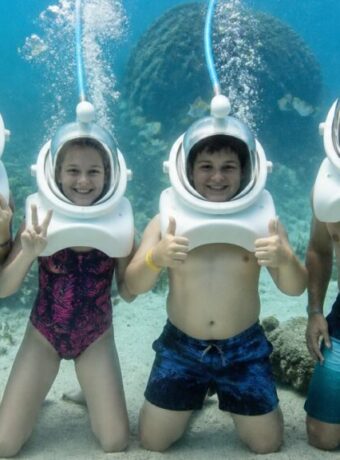
We built our tour for exactly this crowd. Everyone walks the same reef, at the same pace, with a guide beside them.
You get all equipment on site, no swimming or certification required, and free entrance to Jeanie’s Beach Club after your dive. Ready to see the reef from the bottom? Walk on the ocean floor in Cozumel and reserve your family’s spot.
Frequently Asked Questions
Is there an age limit for helmet diving?
Most helmet diving operators set a minimum age of around 8, but there is generally no maximum age. Suitability for seniors depends on health and mobility rather than birthday. A 75-year-old in good health who can walk and climb a short ladder may be perfectly fine, while someone with uncontrolled heart conditions should get medical clearance first. Ask the operator about their age policy and any health questionnaire before booking.
Do seniors need to know how to swim to try helmet diving?
No. Helmet diving is designed for non-swimmers. You breathe naturally inside the helmet, which stays supplied with air, and you walk along the ocean floor while holding a guide rail or staying close to an instructor. Water confidence helps, but swimming ability is not required. If you feel nervous, tell the crew in advance so they can give you extra attention during the briefing and descent.
What health conditions could make helmet diving unsafe?
Conditions that affect the heart, lungs, or blood pressure deserve a doctor’s review before you book. Uncontrolled high blood pressure, recent heart surgery, epilepsy, pregnancy, and certain ear or sinus problems are common reasons operators ask for medical clearance. Bring an up-to-date medication list and mention any pre-existing conditions on the health form. When in doubt, get written approval from your physician rather than guessing.
Is helmet diving safer than scuba diving for older adults?
For many seniors, helmet diving is easier on the body. You do not carry a tank on your back, you do not need certification, and you stay at shallow depths where pressure exposure is limited. Scuba requires training, buoyancy control, and physical effort that can strain the back and heart. Helmet diving removes much of that load, though it still involves walking on an uneven seabed, so mobility and balance matter.
If you are still weighing whether your health history fits, start with your doctor and our health waiver. Then book with SEA TREK Cozumel and let our guides handle the rest, from gear fitting to a hand at your side on the ladder.